
Memory Improvement Course
Stop forgetting what you study, who you meet, and what you need to know. This course gives you a complete, science-backed toolkit — from memory palaces to spaced repetition — to dramatically sharpen your recall. Whether you're a student, a professional, or simply tired of a leaky memory, these techniques deliver real, measurable results.
What you will learn:
You will learn how memory actually works at a biological level, then immediately apply that knowledge through proven techniques. The course covers spaced repetition, retrieval practice, the memory palace method, and a full suite of mnemonic systems. You will also discover how sleep, exercise, nutrition, and stress directly affect your ability to remember. Practical modules address remembering names and faces, delivering presentations without notes, and retaining technical knowledge on the job. By the end, you will have a personalized memory improvement plan built around your specific goals and daily routine.
How you study in practice Memory Improvement Course
How you practice Memory Improvement Course
For companies looking to train their teams
With Dedika for businesses, the course includes exercises and examples tailored to your own business and the way your company needs.

Course Content
8 Chapters • 33 LessonsDuration between 4 and 360 hours (you decide)
Chapter 1HideHide detailsSee detailsHow Memory Works: Core Foundations
How Memory Works: Core Foundations
Lesson 1 • The Brain Structures Behind Memory
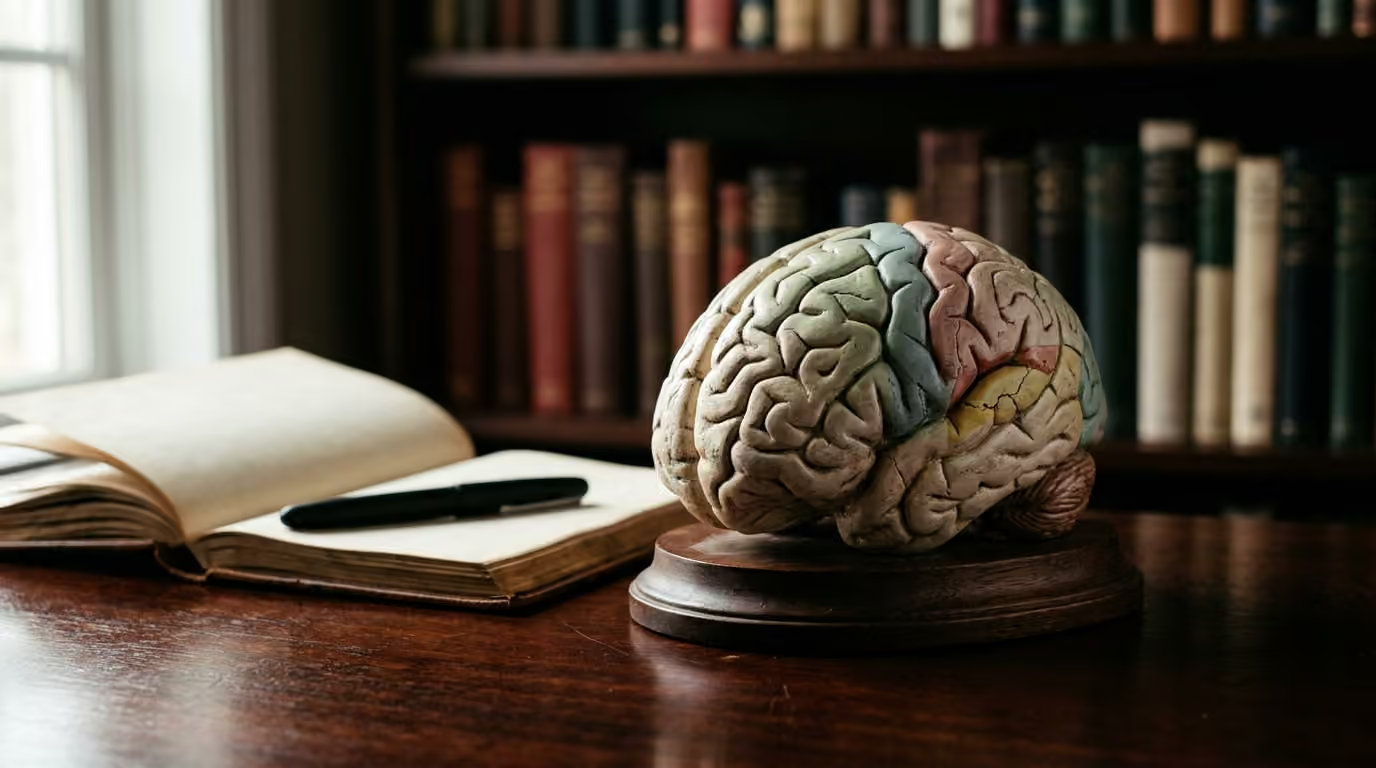
Maps key brain regions—hippocampus, prefrontal cortex, amygdala—to memory functions. Provides biological context for technique effectiveness.
Lesson 2 • Common Memory Myths Debunked
Corrects widespread misconceptions about photographic memory and brain capacity. Builds realistic expectations before technique training begins.
Lesson 3 • The Three Stages of Memory
Covers encoding, storage, and retrieval as sequential processes. Grounds all later techniques in a unified model of how memories form.
Lesson 4 • Types of Memory Systems
Distinguishes declarative, procedural, and episodic memory. Clarifies which system each improvement technique targets.
Chapter 2HideHide detailsSee detailsAttention and Encoding Fundamentals
Attention and Encoding Fundamentals
Lesson 1 • Active Encoding Techniques
Introduces elaborative interrogation, self-explanation, and generation effects. Moves students from passive reading to deep processing.
Lesson 2 • Why Attention Drives Encoding
Explains the direct link between focused attention and memory strength. Sets the foundation for all active encoding strategies.
Lesson 3 • Eliminating Distraction for Better Recall
Identifies internal and external distraction sources that weaken encoding. Provides actionable strategies to create focused learning conditions.
Lesson 4 • Emotional and Sensory Encoding Boosters
Leverages emotion, novelty, and multisensory input to strengthen memory traces. Connects amygdala function from Chapter 1 to practical encoding.
Chapter 3HideHide detailsSee detailsSpaced Repetition and Retrieval Practice
Spaced Repetition and Retrieval Practice
Lesson 1 • The Spacing Effect Explained
Defines the forgetting curve and explains why distributed practice outperforms massed study. Motivates adoption of spaced schedules.
Lesson 2 • Retrieval Practice: Testing as Learning
Demonstrates that self-testing strengthens memory more than re-reading. Introduces free recall, cued recall, and practice testing formats.
Lesson 3 • Combining Spacing and Retrieval
Integrates both techniques into a unified study cycle for maximum retention. Students design a complete review protocol for real material.
Lesson 4 • Building a Spaced Repetition System
Guides creation of a personal spaced repetition schedule using cards or digital tools. Produces a working review system by section end.
Chapter 4HideHide detailsSee detailsVisualization and the Memory Palace
Visualization and the Memory Palace
Lesson 1 • Building Vivid Mental Images
Trains the skill of creating exaggerated, multisensory mental images. Directly prepares students for memory palace placement.
Lesson 2 • The Power of Mental Imagery
Explains the picture superiority effect and dual-coding theory. Establishes why visual encoding dramatically outperforms verbal-only methods.
Lesson 3 • Constructing Your Memory Palace
Step-by-step method for selecting a familiar location and defining loci. Students build their first palace with at least ten stations.
Lesson 4 • Applying the Memory Palace to Real Content
Applies the palace to lists, speeches, and structured information. Bridges technique practice to professional and academic use cases.
Chapter 5HideHide detailsSee detailsMnemonics and Association Techniques
Mnemonics and Association Techniques
Lesson 1 • Acronyms, Acrostics, and Rhymes
Covers classic verbal mnemonics for lists and sequences. Provides immediate tools applicable to names, terminology, and procedures.
Lesson 2 • The Link and Story Methods
Uses narrative chains to connect unrelated items into memorable sequences. Complements the memory palace with a portable, quick-build alternative.
Lesson 3 • The Major System for Long Numbers
Introduces the phonetic major system to convert digits into consonant sounds and words. Enables memorization of phone numbers, dates, and statistics.
Lesson 4 • The Peg System for Numbers
Teaches the number-shape and number-rhyme peg systems for ordered recall. Enables fast memorization of numbered lists and rankings.
Chapter 6HideHide detailsSee detailsMemory for Names, Faces, and People
Memory for Names, Faces, and People
Lesson 1 • Practicing Name Recall in Real Situations
Provides drills and real-world practice strategies for networking events and meetings. Converts technique knowledge into automatic social habit.
Lesson 2 • The Face-Name Association Method
Teaches a four-step process: observe, select a feature, create an image, and link to the name. Produces immediate improvement in name recall.
Lesson 3 • Why Names Are Hard to Remember
Analyzes the cognitive reasons names resist encoding compared to other information. Reframes the challenge as a skill gap, not a talent deficit.
Lesson 4 • Deepening People Memory Beyond Names
Extends memory to roles, interests, and context for richer recall. Builds relationship intelligence alongside name retention.
Chapter 7HideHide detailsSee detailsLifestyle Factors That Optimize Memory
Lifestyle Factors That Optimize Memory
Lesson 1 • Sleep and Memory Consolidation
Explains how slow-wave and REM sleep consolidate memories formed during the day. Motivates consistent sleep hygiene as a core memory strategy.
Lesson 2 • Stress, Cortisol, and Memory Impairment
Explains how chronic stress and elevated cortisol damage hippocampal function. Introduces stress-reduction practices that protect memory performance.
Lesson 3 • Exercise and Neurogenesis
Links aerobic exercise to hippocampal neurogenesis and BDNF production. Provides evidence-based exercise recommendations for memory enhancement.
Lesson 4 • Nutrition for Cognitive Performance
Identifies dietary patterns and nutrients that support memory and reduce cognitive decline. Translates research into practical daily food choices.
Chapter 8HideHide detailsSee detailsAdvanced Memory Strategies and Mastery
Advanced Memory Strategies and Mastery
Lesson 1 • Speed and Efficiency in Memorization
Develops faster image creation, quicker palace navigation, and rapid encoding habits. Targets competitive and high-volume memorization demands.
Lesson 2 • Combining Techniques for Complex Material
Shows how to layer mnemonics, palaces, and spaced retrieval for dense content. Addresses textbooks, technical manuals, and professional knowledge bases.
Lesson 3 • Maintaining Memory Gains Long-Term
Addresses how to sustain improvements through habit stacking and periodic review. Closes the course with a lifelong learning mindset.
Lesson 4 • Metacognition and Memory Monitoring
Trains awareness of one's own memory strengths, weaknesses, and illusions. Prevents overconfidence and guides smarter study decisions.
Lesson 5 • Designing Your Personal Memory System
Guides creation of a written, individualized memory improvement plan with goals and metrics. Produces a sustainable, self-directed practice framework.
Your valid completion certificate
This course is for you:
Medical students: must retain vast volumes of terminology and clinical procedures.
Sales professionals: build rapport by remembering client names, needs, and histories.
Lawyers: need reliable recall of case details, statutes, and procedural sequences.
Lifelong learners: pursue new subjects and want knowledge to actually stick long-term.
Managers: strengthen team relationships by remembering people's roles and contributions accurately.
Career changers: absorb an entirely new field's knowledge base quickly and confidently.
What our students say
Your classes are perfect. I purchased the one-year package and finally have the opportunity to follow various topics of interest without needing to switch platforms... I thank you for everything you do, I've already recommended you to other people...

I like how the lessons are straight to the point and how I can switch chapters and skip content I don't need.

I like the content and the presentation style and video transcription, which speeds up the process!

The platform is fast, simple to use. The diversity of content and complementary videos really help with learning.

Top trainings












FAQ
Who is Dedika?
Is the certificate valid in United States?
Are the courses free?
What is the course workload?
What are the courses like?
How do the courses work?
What is the duration of the courses?
What is the cost or price of the courses?
What is an EAD or online course and how does it work?
PDF Course